I’m a writer, so I’ll stay in my lane and focus this blog post on the use of AI specifically in the field of creative writing, including publishing. Also, when I refer to AI from here on out, I’m referring primarily to generative AI that, upon receiving a requested prompt, spits out a final product or some kind of creative answer for any step of the creative writing or publishing process.
Let’s start with what AI is and what it is not.
AI is a tool.
AI is not alive. It does not live and breathe like a human or even an ant. Terminator 2: Judgment Day is not real. There are no metal feet crushing human skulls as an army of red-eyed, AI-fueled robots sets fire to humanity.
I make a point of saying this because I’ve noticed a fear, even a paranoia, growing and mutating around the topic of AI within artistic spheres. Of course, the writing world has not been exempt from participating in this borderline hysteria. Indeed, fear in the writing world seems to have muddled the very definition of AI so that it is no longer simply an advanced tool that analyzes mass amounts of information to provide a variety of results at an unprecedented speed with or without close human supervision but an evil thing that is killing art and humanity. In fact, anything, anything at all, that looks touched by the unholy fingers of a digital tool can be subject to a bright spotlight, much squinting at, and a harsh interrogation with a set judgment in mind. Photoshop? Illustrator? Canva? Spellcheck? They’re a sign. They’re all a sign of AI. Digital equals AI, and all AI is evil! Generative, machine learning, I don’t care! Burn this AI-generated monstrosity and its evil, AI-using creator at the stake before it’s too late and the robots take over and we have to be exposed to Arnold Schwarzenegger’s naked butt!
Don’t get me wrong. I, too, have no wish to be exposed to Arnold Schwarzenegger’s naked butt in the near future or any version of my future. But this growing fear of AI is making so many in the writing sphere forget that we, humankind, have been using all sorts of digital tools, from Photoshop to Word, in perfectly productive and responsible ways for a very long time now. In fact, many, many people across the arts use digital tools, including AI, in fair and productive ways that advance society. Yes, AI is an unprecedented type of technology that can pump out original content. But we should not let our fear of AI blacken our perspective of all digital tools ever made or more importantly, allow fear to dictate how we perceive those who use such tools. Not everything digital is evil, and not everything digital is AI. People who use digital tools are not automatically evil, and not everyone who uses AI is sucking out humanity’s soul. If that were true, we should have all started freaking out way before any kind of AI, generative or otherwise, ever appeared on the writing scene. AI filters our spam emails for crying out loud.
Fear never provides a solid foundation upon which we can build reason. So, let us stop fearing AI. Instead, let us think deeply. For although AI is a non-living tool, it is still an extremely powerful tool, being the unique and advanced technology that it is, and like any powerful tool, it can be used destructively. Let us think carefully before using such a tool.
Let me say this loud and clear: I am opposed to using AI in creative writing. Don’t do it.
If you use AI for any part of your creative writing process, you will contribute to the poisoning of the arts and the slow death of the human souls who consume those arts. From making AI tell you what your next book should be about instead of coming up with your own original idea to using AI to produce any of the words and sentences that will compose your book, you should not be using AI for your creative writing. It should go without saying that you shouldn’t use AI to write an entire book.
However, I don’t want to be legalistic toward AI usage either. Again, we shouldn’t automatically define AI as “evil,” and all people who use AI shouldn’t be dragged out of their homes by the anti-AI mob and stoned to death. Plus, like it or not, AI is very much here to stay, so we might as well examine how we can use it ethically going forward, for it does have its uses, even in the writing world.
For example, if a full-time mom of a moody teenage son who plays way too much Minecraft, an adolescent daughter who’s starting to flirt with older boys, and a toddler who, for whatever reason, has a great penchant for shoving foreign objects up his nose, if such a mother wants to use AI to make marketing images for her books so that she can wake up three hours earlier than everyone else and invest as much of those three precious hours into her writing rather than all the countless advertising needs required to reach the right readers, then I say, long live AI and let the poor woman use the tools that are at her disposal! Unlike AI, writers are not soulless machines but human beings with only so much time and energy to give. It would be ridiculous to deprive ourselves of a perfectly good tool that enables us to focus as much time and energy as possible on our actual craft, which is not the creation of marketing images but creative writing. (So, to all the social media influencers and even writers who hate on authors who use some kind of AI in their marketing endeavors but none in their actual writing, I say that you, good sirs and madams, are legalistic snobs who are robotically upholding antiquated standards at the cost of true artistic progress. Also, you should stop hypocritically using Canva templates and AI-suggested music for your own social media posts if you’re going to be that judgmental.)
If, however, a city were to, say, hold a short story contest that celebrates the craft of storytelling, judges should have every right and need to disqualify any AI-generated works or AI-assisted works. AI should play zero roles in the creation of any given submission. The spirit of such a contest is to uphold the human qualities which only the process of writing a good story from start to finish can hone. What an insult it would be to compare writers who clock in at their writing desks after their nine-to-five and well into their weekends, grinding away at their craft to try and submit something worthy, to compare such artists with people who wrinkled their noses at the thought of writing and instead, submitted an AI-generated rush job in the hopes of winning the cash prize.
Clearly, both appropriate and inappropriate uses of AI exist in the literary sphere. As such, we, the potential users of AI, must take the time to determine when we should shun AI and those who use it and conversely, when shunning something or someone that’s AI-related would simply result in legalism, the stubborn stupidity that withholds perfectly good things simply for the sake of doing so. The question is, then, how do we determine when AI usage is appropriate and when it is not? I would suggest the following rule of thumb: take a step back and ask yourself first, “What is the purpose of writing?”
I believe the purpose of writing is freedom. And what is freedom? It is discipline. What is to be gained from discipline? The ability to make decisions, to choose right from wrong and to know why you defined right as right and wrong as wrong rather than living enslaved to confusion or the opinions of others. Writing is a tool meant to refine human reason, that critical attribute that separates a strong person from a weaker one and even a weak man from a rabid animal. Albert Camus, one of the youngest recipients of the Nobel Prize in Literature, put it much more eloquently in his speech, “Create Dangerously,” when he said, “Free artists are those who, with great difficulty, create order themselves. The more chaos they must bring order to, the stricter their rules will be, and the more they will have affirmed their freedom. Gide said something that I have always agreed with, even though it might be misunderstood: ‘Art lives from constraint and dies from freedom.’”
Freedom is not the license to do whatever you want however you want but an exercise of willful discipline that yields the peace and wisdom that constitute true freedom. The free writer, which is to say, the true writer, must be a master of the painful practice of self-discipline, for that is the only way to make true art. The practice of creative writing should be to the writer what the practice of meditating under a waterfall is to a Buddhist monk. You must subject yourself to a kind of discomfort that can be so cold as to be hot and choose again and again not to run away from the painful tons pounding down onto your head. The longer you endure, the more you harden against the pain, strengthening your fortitude and building a tolerance for hardship that allows you to settle into a state of peace that can bear any amount of discomfort in any area of life.
Yet, it is discomfort, that inescapable necessity in creative writing, that causes so many people to turn away from the true purpose of writing and instead, eye the temptation of AI.
Why sit at your desk for hours, wringing your brains red to come up with one perfect word within one sentence out of the hundreds that you need to write for your novel if you can simply tap AI awake and have it serve you something in less than a second? After all, it’ll probably give you a similar or even the same word you would have eventually come up with on your own.
Why go through emotional rollercoasters day in and day out as you follow your characters in their sufferings? Why subject yourself to that painful and even traumatic state of creative mania that writers enter while producing their best work when AI, which will never be troubled by the pain and sorrow that you can feel, can create a similar scene or even write a similar book all together?
Why cherish and nurture your own original idea and why pour your soul into that idea for years only to publish your book and discover that no one else cares and that you offered up a part of your heart to the world only to have it tell you that it’s not enough? You could have avoided all the heartache if you’d simply asked AI at the start to tell you what genres and topics are trending these days. AI would have given you the idea that would have actually sold.
AI is a real temptation because there is very real, hard, and even excruciating work involved in writing. Non-creatives often criticize the arts as some abstract nonsense that just about anybody can pull out of their butts and label as intelligent. But such criticism only comes from people who have never truly tried to apply themselves to an artistic craft. True craftsmen know how much blood, sweat, and tears are shed in the creation of even a single work of art. Writing is not a flippant thing that depends on whim but is founded on choosing again and again to endure hard work no matter the pain and even at great cost. It is meant to be used as a tool which allows its user to grip discomfort by the horns and exercise the self-discipline needed to overcome discomfort.
As cliche as it may sound, it really is the journey and not the end result that is the purpose of writing. Yes, the journey is a long and difficult one, but only the traveler brave enough to take the first daunting step and then every other step after that, all the way to the bitter end, can discover each secret treasure, both anticipated and unanticipated, that will transform that traveler into a warrior. Each step is the art itself. And this is exactly why it is so sacrilegious to use AI to create your writing for you at any step.
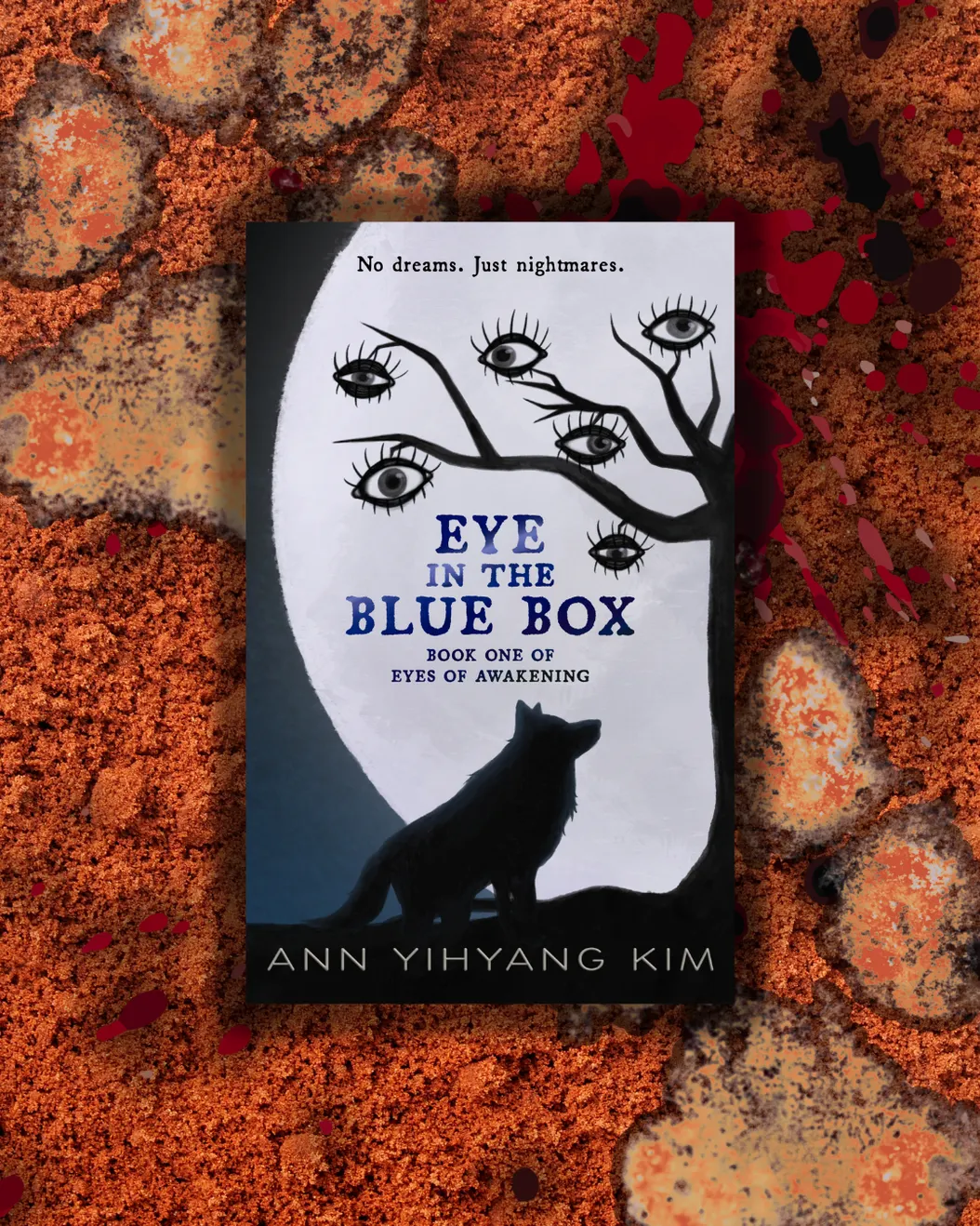
I remember during the writing of Eye in the Blue Box, I had to rack my brains for three hours straight before finally landing on the word “skunky” to describe the smell of the smoke that James walks through in one of the many planes Crew Blue explores. The smoke was a minor detail, just something to help ground the scene among all the fantastical elements surrounding it. If I’d chosen to excise all mention of the smoke, it would not have made a difference in the plot or the characters’ journeys. But the joy that brightened my heart when I finally found the word for which I’d wandered the dim crevices of mind for three hours, the satisfaction that gleamed when a reader, who knew nothing of the effort that had gone into choosing that word, pointed out its apt use, I cannot fully describe what those moments, those small yet giant victories, felt like to anyone who has not tasted the sweetness of hard work. These small bites of success strengthened my tolerance for grueling work not only within my craft but in my nine-to-five, my relationships, and even seemingly more frivolous endeavors, like my fitness journey. Life is interdisciplinary. A worthy skill gained in one space of life can and will transfer over to others. The ability to sit well under the pressure of discomfort does not stay isolated within my writing just because such a skill was refined through writing. When writing changes a part of me for the better, it also changes me, the whole person, for the better.
Likewise, a vice grown and fed in one part of life will inevitably plant itself into another, choking the good that could have been. Do you really think someone who calls herself a writer yet refuses to exercise enough patience to string two of her own words together for her own book can grow into a good friend, a good mother, a good neighbor, a good citizen, an excellent human being? Can she avoid defining herself as a cheater?
I always marvel at full-blown adults who dissolve into a puddle of tears under a drop of pressure or feel justified in screaming at their honest waiter or insist that the world owes them only wealth and prosperity because they are above any kind of suffering. But perhaps these so-called adults never tried to write a story before. Maybe they’ve lived their entire lives thinking that writing and art are one big tiring endeavor that should be waved aside. Maybe that’s why they feel comfortable using AI to fling something into the deep and beautiful sea of literary works and grabbing any cash prize or shred of glory that happen to float to the top. A well-wrought word is not just one word out of thousands in a book. It is proof that the writer grew in the patience and intelligence that define her humanity.
While writing one of the chapters in Tree of Eyes, I entered a flow state that lasted for three days. During those three days, I barely ate, drank, or slept. All I could do was write, write, write out the scenes that were flooding my mind like memories from a past life suddenly remembered. I wrote around forty perfect pages in those three days, forty pages that barely needed any editing. You can only imagine how exhausted I was once those three days had finally ended. It wasn’t just the physical toll of neglecting food and sleep. Writing that chapter had, somehow, through the lightning rod that is creative writing, unlocked memories I’d previously suppressed and forced me to confront some of the most painful and unwanted parts of my past. I had to reexamine so many chapters of my life that I’d been so sure I’d figured out and concluded long ago. It took me years to process the thoughts and memories those manic three days stirred up, and reevaluating so much of what I’d believed to be true was, at times, so heavy a task that I feared I’d written Tree of Eyes only to break my own heart over and over without end.
But now that I’ve weathered the storm, untangled my mysteries, and come to the end of the long and harrowing path which writing that single chapter had set me on, I can say that it was only through that painful journey that I was able to apply the healing balm of careful thought onto the wounds that would have otherwise festered into incurable suffering. I’m not sure if anything other than that session of manic writing could have healed me. In fact, I doubt that I would have been able to find a better doctor than writing. I think God gave me writing along with each and every difficult step that go with it because He knew the art of writing would prove to be a sure cure for my broken heart.
But what if I’d used AI instead to write that chapter? First of all, I doubt even AI with all its technological advances would have been able to write the same exact chapter because that chapter took so many twists and turns which I’d never planned for that I wouldn’t have been able to give AI the right prompts to begin with. But even if I somehow had been able to give AI the correct specifications and AI had ultimately produced a similar chapter or even the same exact chapter, I doubt I would have recognized the chapter for the gold that it was. If I'd used AI, I wouldn't have gone through all the ups and downs of creating that chapter myself, and consequently, I wouldn't have learned through the gut feeling that only labor can instill that this was, indeed, the right chapter. Instead, I would have read what AI gave me and thought, “Well, that’s not what I wanted. I never planned for these characters to act this way!” and kept prodding AI to give me only what I’d expected all along.
But let’s say that I’d somehow managed to give AI the right prompts, received the same exact chapter, and then also recognized that this was the chapter I’d meant to include in the book all along. Would I have been able to grasp the cure that only the journey of writing was able to give me? Would I have reaped the benefits that can only be found through the hard, painful work of creating from beginning to end? No. In fact, I might still be struggling to this very day with all the emotional wounds I hadn’t known were festering somewhere deep in my heart, the wounds that writing that chapter from painful start to painful finish healed.
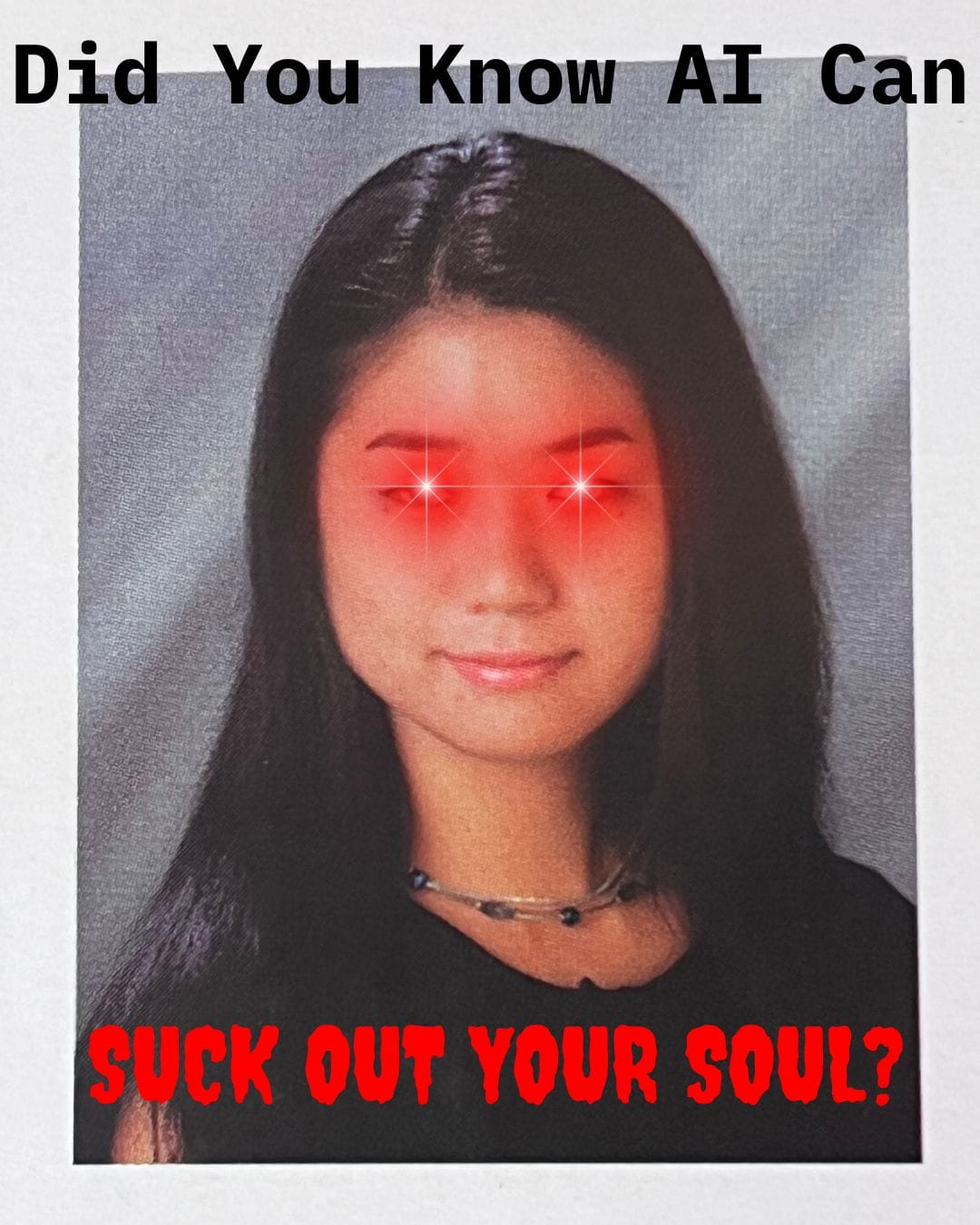
“Did You Know AI Can SUCK OUT YOUR SOUL?” I know I made the title of this blog post funny and hyperbolic, but in all seriousness, I hope the examples above show that AI can, indeed, rob you of the opportunities to define and refine your humanity. In that way, AI actually kind of can suck out your soul. But as I’ve also tried to explain, the real soul-sucking monster isn’t the tool, even if that tool is incredibly powerful. The real blame lies with the people who continue to indulge in their own laziness and greed and use powerful tools, whether it’s AI or the art of writing itself, irresponsibly.
We shouldn’t be surprised that so many so-called writers are willing to forsake the very purpose of what they profess to be their own craft, though. Whether it’s because they can’t be bothered with anything uncomfortable whatsoever or because they crave riches and glory more than integrity, these kinds of people have long been using powerful tools irresponsibly even before AI made its presence known in the writing scene. Want proof? Just go to any Barnes & Noble, and you’ll see how people have been misusing the powerful and precious tool that is writing. One hundred percent human-made, sloppy, thoughtless, and formulaic writing has more and more become the norm, even the standard, in the publishing world, so much so that half the books I see both within the traditionally-published and self-published spheres may as well have been written by AI. The misuse of AI is simply one more extension of the human carelessness and stupidity that have long run rampant in the writing world.
But maybe I shouldn’t be so harsh. The book market demands its consumers to become gluttons in order to stay happy, so if authors don’t mass produce books as if they, themselves, were machines, then they’ll be considered stale or bad investments and left in the dust. Anything new is also a threat. Writing must remain predictable. Otherwise, both the author and the publisher risk investing in something that will ultimately prove to be a flop. It is a sad truth that surviving in the writing world often requires the relinquishment of freedom.
But in the face of temptation, whether that temptation takes the form of AI or the pressures of publishing, every individual must make an extremely difficult choice. They must first take a step back and ask themselves, “What is the purpose of writing?” Will you choose to let your freedom suffer? Or will you choose to be free, to put in the time and effort that are necessary to create any worthy work, even at the risk of working a regular nine-to-five for the rest of your life or living in perpetual obscurity? It is a hard choice as well as an unfair one. It is a simple question with an answer that’s as hard to swallow as truth. But as Albert Camus so rightfully said, “Freedom in art is worth very little when it has no meaning other than assuring that the artist has an easy life.” He also explained that “Like all freedom, [artistic freedom] is a never-ending risk, a grueling experience, and that is why today we flee from such risk, just as we flee from freedom, which demands so much of us, and instead rush headlong into all kinds of enslavement, to at least obtain some comfort in our souls.”
Don’t tell me that part of your dream was to pump out sloppy or fake work for the sake of your dream. You know that’s a lie. “Every great work of art makes humanity richer and more admirable, and that is its only secret.” Don’t give in and use writing, this powerful and ancient tool that mankind has used to improve itself and help one another throughout the ages, don’t use such a wonderful tool for evil.
We can use a hammer to build housing for those in need. We can also use a hammer to murder the homeless. All tools, whether they’re as simple as a hammer or as technologically advanced as AI or as ancient as writing, require the user to make decisions. We, the living, determine if a tool will cultivate good or sow evil. So let us choose wisely.